
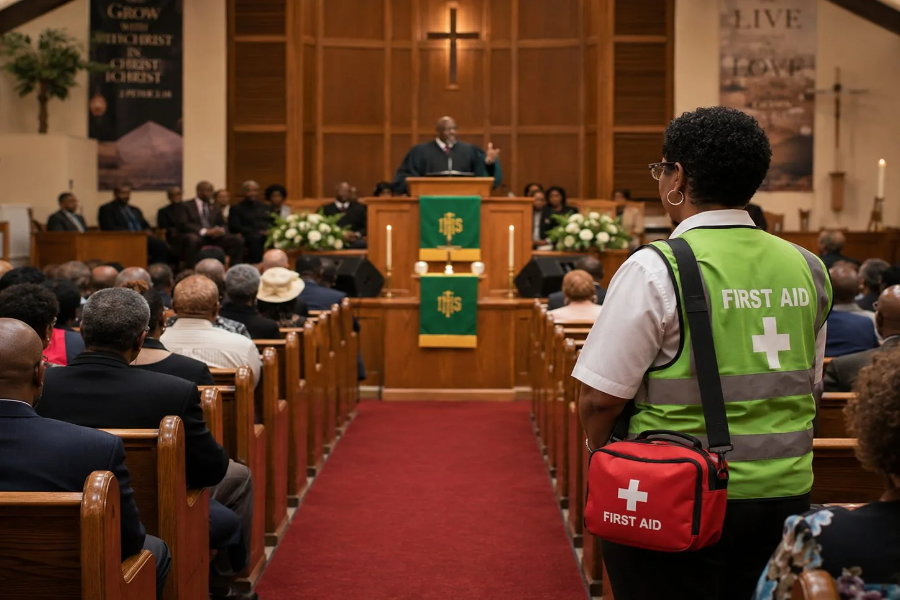
Congregations across Ottawa gather some of the most consistent, recurring crowds in the city each week, often including a higher proportion of older adults than many other regular gatherings, which means the ushers, greeters, and volunteers who staff those services are quietly positioned as a community’s first line of response if a medical emergency happens during worship. Preparing those volunteers with proper CPR and Faith Communities first aid training turns that existing role into an actual capability, not just a title.
Key Takeaways
- Weekly worship gatherings often include a higher concentration of older adults, a demographic more likely to experience cardiac events, falls, or other sudden medical needs.
- Ushers, greeters, and hospitality volunteers are already positioned near the congregation each week, making them natural candidates for first aid and CPR training.
- CPR and First Aid training gives volunteer teams the specific, practiced skills needed to respond to a cardiac or medical emergency during a service.
- Group training options let an entire volunteer team, ushers, greeters, facilities staff, certify together on a schedule that fits around service times.
- Certificates are typically issued within 48 hours of successful completion, and a free skills retake within 90 days supports volunteers who want to be confident before relying on the skill.
Why Are Places of Worship a Natural Setting for First Aid Readiness?
Weekly services bring together large, recurring groups of people, often spanning a wide age range and including many older congregants, in a single indoor space for an extended period. This combination, size, regularity, and demographic mix, means that over time, the statistical likelihood of a medical event occurring during a service is not negligible. Congregations already have a built-in structure of volunteers, ushers, greeters, hospitality teams, who are present and attentive during every gathering. Extending that existing structure to include basic emergency response training is a natural fit rather than an added burden, since the people are already there and already paying attention to the room.
Who Within a Congregation Should Consider Getting Trained?
Ushers and greeters are the most obvious candidates, since their role already involves watching over the congregation and being the first to notice if someone needs help. Beyond that front-facing group, facilities staff, choir or music leaders, and volunteers who regularly staff coffee hours or fellowship events are also well positioned, simply because they’re present at so many different gatherings throughout the week. Faith communities don’t need every member trained, but having a reliable core group, spread across different service times and volunteer roles, means someone with the right skills is very likely to be present whenever the congregation gathers. This kind of layered coverage is a common approach across community organizations generally, not something unique to religious settings.
How Does Group Training Work for a Congregation?
Group or on-site training allows a congregation to bring an instructor to their own building, certifying a cohort of volunteers together rather than sending individuals to separate public courses on their own time. This matters practically for faith communities, since volunteer schedules are often built around service times, committee meetings, and other commitments that make individual course attendance difficult to coordinate. A congregation might choose to train its usher team and a handful of other regular volunteers in a single session, timed around a day when the building is otherwise free. The result is a group of people who trained together, which tends to build shared confidence in how the team would actually respond if something happened during a service.
What Should a Congregation Look for When Choosing a Training Provider?
A congregation considering this step should look for a provider offering both the hands-on skills practice that builds real confidence and the flexibility to schedule training around the community’s own calendar. Certificates issued quickly after course completion, often within 48 hours, matter for congregations that want their volunteer roster updated without a long wait. A free skills retake within a set window, commonly around 90 days, also gives volunteers a low-pressure way to solidify a skill they may not have practiced in years. Congregations in Ottawa exploring options to register for Coast2Coast first aid training in Ottawa can typically arrange group sessions that fit around existing volunteer commitments rather than requiring separate individual bookings.
Does This Approach Apply Across Different Faith Traditions?
Yes. The underlying need, a recurring gathering of people, a volunteer structure already in place, and a meaningful proportion of older attendees, is common across many different faith traditions and community gathering styles, regardless of specific religious practice. Basic first aid and CPR training is not tied to any particular denomination or belief system; it addresses a practical, shared reality of communities that gather regularly and care for their members. Congregations of different traditions across Ottawa have approached this the same practical way: identify the volunteers already present each week, then give them the specific skills to act if the moment calls for it. The respectful, non-denominational nature of the training reflects that it is addressing a human need common to every community, not a feature of any one faith.
Read more: How To Start My Own Plumbing Business, How To Build 9 Trusted Clients
FAQs
Does a congregation need to train every volunteer, or just a few? A core group, typically ushers, greeters, and a few other regular volunteers, spread across different service times, usually provides reasonable coverage without requiring the entire congregation to certify.
Can training be scheduled around a congregation’s own service times and building availability? Yes, group and on-site training options allow an instructor to come to the congregation’s own building, and scheduling is generally arranged to fit around existing service and meeting times.
How long does a first aid or CPR certification last for a volunteer team? Certificates are generally valid for three years, with an annual CPR and AED refresher recommended to keep the volunteer team’s skills current between full recertifications.

Dived shares meaningful prayers, faith-inspired messages, blessings, and spiritual insights to bring peace, hope, and divine sense to daily life.